

Celayix Launches Autonomous Workforce Operations With New Workflow Engine
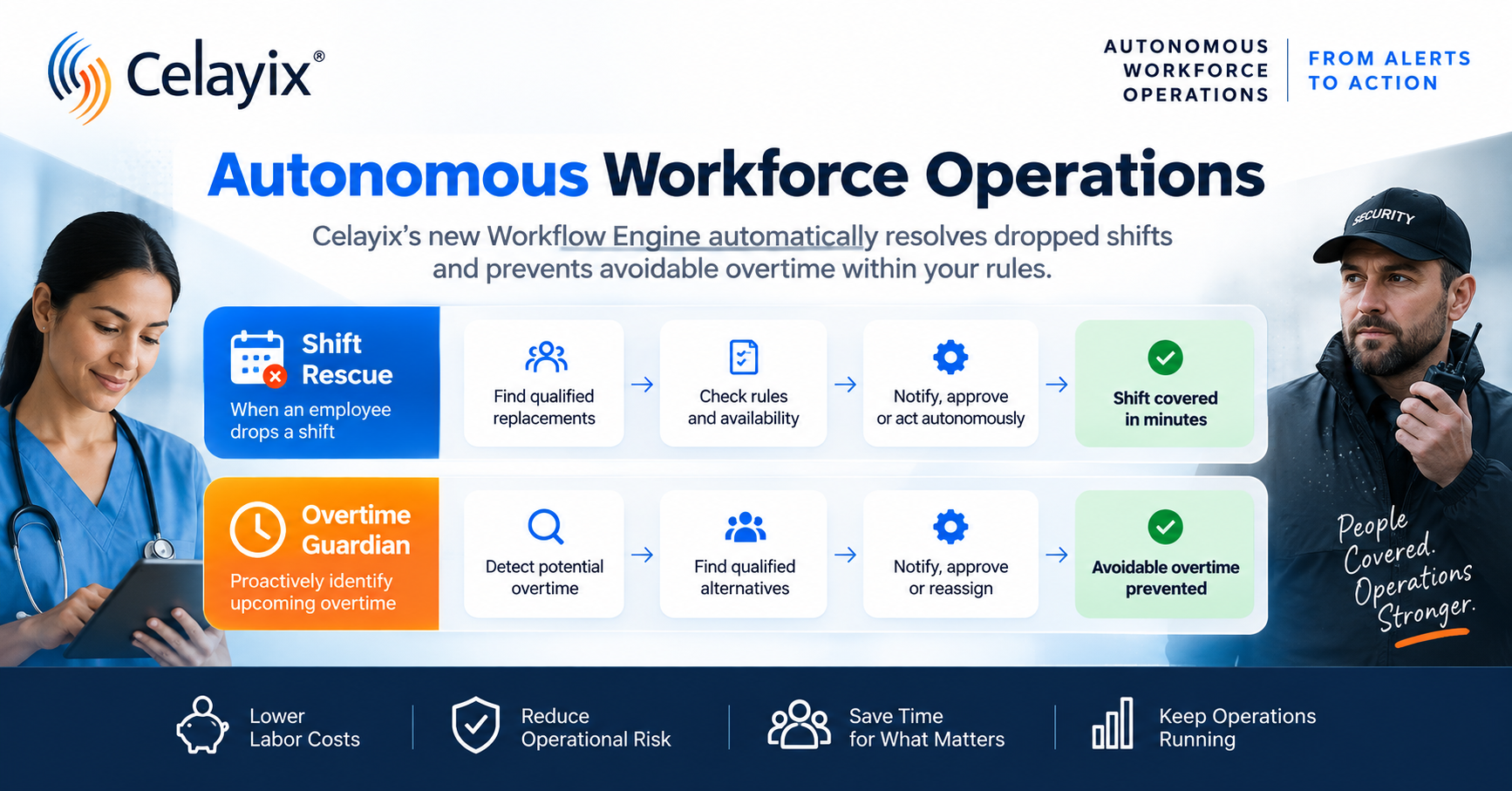
Celayix Autonomous Workforce Operations: From Alerts to Action
Celayix Launches Autonomous Workforce Operations to Resolve Dropped Shifts and Prevent Avoidable Overtime
VANCOUVER, BC, CANADA, September 9, 2026 /EINPresswire.com/ -- Celayix, a provider of shift management software for organizations where every shift matters, today announced the Celayix Autonomous Workflow Engine, a new platform capability that enables organizations to automate workforce operations while maintaining control over the actions the system can take.
The new engine moves workforce management beyond alerts and recommendations to governed autonomous action. Depending on customer-defined rules and autonomy levels, Celayix can identify a workforce issue, determine the appropriate response, and execute the workflow with minimal or no human intervention.
The first autonomous workflows available on the engine are Shift Rescue and Overtime Guardian, designed to address two persistent challenges for shift-based organizations: filling dropped shifts and preventing avoidable overtime before it occurs.
From Workforce Alerts to Autonomous Action
Traditional workforce management and employee scheduling systems can alert managers when staffing problems occur. But resolving those problems — finding qualified replacements, checking availability, evaluating overtime and union rules, contacting employees, obtaining approvals, and updating the schedule — can still require significant manual coordination.
The Celayix Autonomous Workflow Engine is designed to automate that work.
Shift Rescue is triggered when an employee drops a shift. Celayix evaluates potential replacements based on qualifications, availability, overtime status, scheduling rules, and other customer-defined criteria.
Depending on the organization's configured autonomy level, Shift Rescue can notify a manager and recommend replacements, request approval before taking action, or autonomously execute the appropriate replacement workflow.
Overtime Guardian proactively reviews upcoming schedules to identify potential overtime before it is worked. When avoidable overtime is detected, Celayix can notify managers, recommend qualified alternatives, or initiate the appropriate reassignment workflow.
Every decision and action is recorded, providing organizations with visibility and an audit trail of how workforce exceptions were handled.
“Traditional workforce software tells you there is a problem and waits for someone to fix it,” said Gurmit Dhaliwal, CEO of Celayix. “Autonomous workforce operations change that model. Celayix can identify the problem, determine the appropriate response and take action — while remaining within the rules and level of authority established by the customer.”
Customers Decide How Autonomous Celayix Can Be
A central part of the Celayix approach is customer-controlled autonomy. Organizations can configure each workflow to operate at one of three levels:
Notification Only — Celayix identifies the issue and notifies the appropriate people.
Approval Required — Celayix identifies the issue, recommends an action and waits for authorization before proceeding.
Full Autonomy — Celayix executes permitted actions autonomously within predefined rules and controls.
“With autonomous workflows, organizations don't have to choose between automation and control,” Dhaliwal said. “They decide which actions Celayix can take autonomously, which require human approval and which should simply generate a notification. This allows customers to adopt greater levels of autonomy at their own pace.”
The Workflow Engine applies workforce scheduling rules covering employee qualifications, availability, overtime, union and seniority requirements, and double-booking prevention.
The engine combines deterministic workforce rules with controlled automation and applies AI selectively where it adds value, including classification, contextual decision support, summarization, and intelligent communications.
Moving From Workforce Management to Autonomous Workforce Operations
The Autonomous Workflow Engine represents Celayix's broader strategy to move shift-based organizations beyond traditional workforce management toward autonomous workforce operations.
Rather than requiring managers to continually monitor schedules and react to exceptions, autonomous workforce operations enable software to detect operational issues, determine the appropriate response, and initiate action within predefined business rules and customer-controlled levels of autonomy.
Shift Rescue and Overtime Guardian are the first autonomous workflows built on the Celayix Workflow Engine, with additional autonomous workforce processes planned for the Celayix Platform.
The capability is particularly applicable to organizations in security, healthcare, hospitality, events, and other shift-based industries, where last-minute staffing changes, employee qualifications, overtime, compliance requirements, and shift coverage create significant operational complexity.
Availability
The Celayix Autonomous Workflow Engine, including Shift Rescue and Overtime Guardian, is now available as part of the Celayix Platform.
To learn more about Celayix Autonomous Workforce Operations or request a demonstration, visit www.celayix.com.
About Celayix
Celayix provides shift management software for organizations with complex scheduling, time and attendance, and workforce operations requirements.
Organizations in security, healthcare, hospitality, events, and other shift-based industries use Celayix to help maintain workforce coverage, manage labor costs, support compliance requirements, and respond to changing operational conditions.
For more than 25 years, Celayix has helped organizations schedule their workforce and keep operations running when conditions change.
Paul Valkama
Celayix Inc.
+1 888-591-5558
p.valkama@celayix.com
Visit us on social media:
LinkedIn
Facebook
YouTube
X
Legal Disclaimer:
EIN Presswire provides this news content "as is" without warranty of any kind. We do not accept any responsibility or liability for the accuracy, content, images, videos, licenses, completeness, legality, or reliability of the information contained in this article. If you have any complaints or copyright issues related to this article, kindly contact the author above.
