

Medical Coding Market to reach USD 68.54 Billion by 2035 at 10.14% CAGR
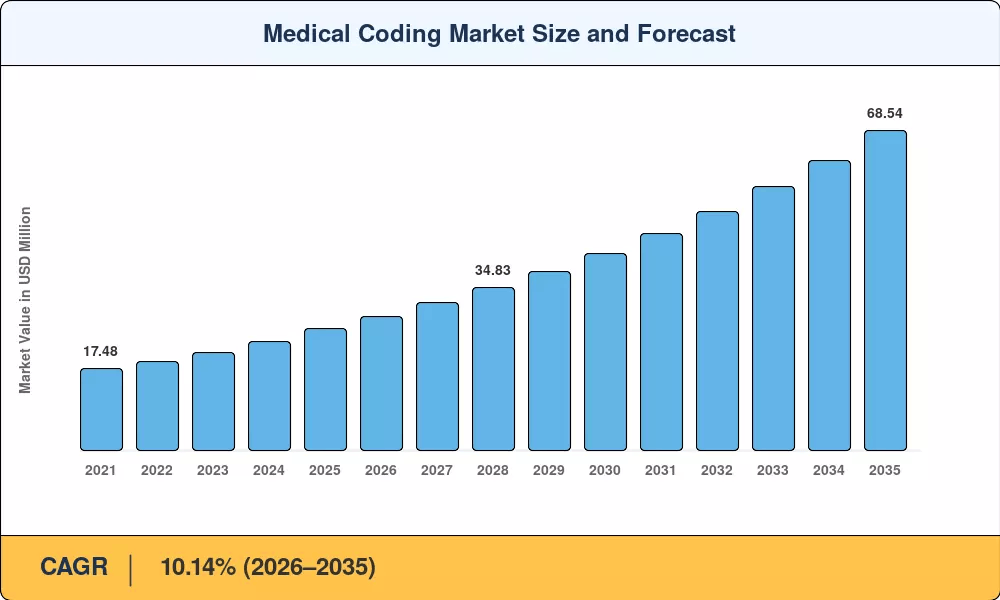
Medical Coding Market Size
Medical Coding Market to Surge from USD 28.71 Billion in 2026 to USD 68.54 Billion by 2035- By ICD-11 Global Transition Mandates, CMS Compliance Requirements
NY, CA, UNITED STATES, June 12, 2026 /EINPresswire.com/ -- As per Market Research Future, the global Medical Coding Market size to reach USD 68.54 Billion by 2035 from USD 28.71 Billion in 2026, at a CAGR of 10.14% during the forecast period 2026--2035. The market base was estimated at USD 26.07 Billion in 2025.The 10.14% CAGR---anchored by structural regulatory compliance demand rather than discretionary healthcare spending---is driven by three converging forces: government-led ICD-11 transition mandates that continue to widen the addressable base for healthcare billing codes infrastructure, sustained CMS reimbursement code expansion that has pulled clinical documentation coding into routine procurement cycles, and the technological shift from legacy on-premise coding engines running on ICD-9 logic toward cloud-hosted, AI-augmented platforms that automate CPT clinical code assignment and indicate documentation deficiencies in real time.
National governments and multilateral health organizations are amplifying this momentum. The U.S. Centers for Medicare & Medicaid Services (CMS) mandate requiring ICD-10 procedure coding compliance across all federally funded programs continues to drive billions in upgrade spending. The World Health Organization's phased ICD-11 rollout---which officially became effective for member-state reporting in January 2022---introduces approximately 55,000 unique diagnostic entities, compelling health systems worldwide to overhaul their clinical documentation coding infrastructure. Between 2023 and 2025, the U.S. Department of Health & Human Services distributed more than USD 1.2 billion in health-IT modernization grants, a large chunk of which was dedicated to revenue cycle and healthcare billing codes automation. CMS processed over 1.3 billion claims in fiscal year 2024, each requiring validated healthcare billing codes. Together, these initiatives are creating the procurement infrastructure and delivery innovation on which the Medical Coding Market depends.
Request A Free Sample:
https://www.marketresearchfuture.com/sample_request/10767
Key Market Trends & Growth Drivers
ICD-11 Global Transition Mandates and CMS Compliance Requirements
National health systems increasingly require standardized diagnosis coding systems for morbidity and mortality reporting, with the WHO's ICD-11 classification introducing approximately 55,000 unique diagnostic entities---representing a drastic structural expansion in clinical specificity over the base version of ICD-10. Globally, early adopters and various member states have established phased alignment pathways extending between 2025 and 2028 to modernize national morbidity frameworks. In the United States, the Department of Health and Human Services (HHS) and the National Committee on Vital and Health Statistics (NCVHS) are continuing evaluation phases; industry projections indicate that foundational preparation for U.S. billing implementation is tracking heavily toward the late 2020s. This shifting global regulatory landscape turns advanced data-readiness and compliant coding systems into a mandatory operational requirement for modern healthcare networks.
CMS expanded bundled payment coverage and released the ICD-10-CM FY2026 update in March 2025, adding 395 new diagnosis codes, including expanded codes for social determinants of health and Long COVID sequelae. This policy shift is estimated to redirect significant annual spending toward advanced medical coding products and services, pulling volume from legacy manual coding workflows. The reimbursement change particularly benefits hospitals and payers, where clinical documentation coding accuracy directly impacts revenue cycle performance. Early-adopter health systems report that computer-assisted coding (CAC) engines utilizing embedded machine learning modules directly within Electronic Health Record (EHR) workflows report significant downstream improvements, including shortened charge-lag times and lower claim denial rates driven by cleaner first-pass code assignments.
AI-NLP Automation and Cloud-SaaS Delivery Shift
Legacy on-premise coding engines, many of which still run on ICD-9 logic, are quickly being replaced by cloud-hosted, AI-augmented platforms that automate CPT clinical code assignment and indicate documentation deficiencies in real time. Autonomous and natural language processing (NLP) computer-assisted coding engines are increasingly handling high volumes of routine clinical documentation. According to longitudinal healthcare software assessments, hospital systems utilizing embedded machine learning modules directly within EHR workflows report significant downstream improvements, including shortened charge-lag times and lower claim denial rates driven by cleaner first-pass code assignments.
This productivity optimization is vital to combat systemic industry shortages: industry workforce data shows that more than 60% of health information departments report being consistently understaffed, with employer demand for credentialed professional coders systematically outpacing the current domestic supply pipeline.
Web and cloud platforms captured over 74% of new Medical Coding Market deployments in 2024, according to KLAS Research. Subscription-based models eliminate upfront capital expenditure and enable remote coding teams---a structural advantage given that 62% of certified coders now work remotely at least part-time. Cloud platforms also accelerate compliance updates: when CMS releases annual ICD-10 procedure coding revisions each October, cloud vendors push patches within 48 hours versus weeks for on-premise installations. The global software and services segment within the Medical Coding Market is expanding at the fastest pace, driven by cloud-based coding automation, NLP-enabled documentation analysis, and AI-enabled charge capture.
National Insurance Expansion and Value-Based Care Transition
India's Ayushman Bharat scheme now covers 500 million beneficiaries, each encounter requiring standardized healthcare billing codes for claims adjudication. The Ayushman Bharat Digital Mission has onboarded 350+ million health IDs, each linked to coded encounter records requiring compliant healthcare billing codes. Indonesia's JKN program and the Philippines' PhilHealth expansion are generating similar demand across ASEAN. These government-led coverage expansions convert previously uncodified patient encounters into structured, reimbursable events---directly enlarging the addressable Medical Coding Market in Asia-Pacific and South America. China's nationwide rollout of CHS-DRG payment reforms is compelling over 15,000 public hospitals to adopt standardized diagnosis coding systems by 2027.
As payers worldwide shift from volume to value, accurate risk-adjustment coding becomes a revenue-critical function. CMS's Hierarchical Condition Category (HCC) model already ties Medicare Advantage payments directly to diagnostic coding accuracy, with each missed ICD-10 procedure coding entry potentially costing plans USD 5,000--15,000 per member annually. The Medical Coding Market will increasingly orient around risk-adjustment accuracy as the economic stakes of clinical documentation coding continue to escalate. This close integration ensures consistent, long-term coding demand tied to quality measurement and reimbursement optimization, embedding the Medical Coding Market ever deeper into standard healthcare workflows.
Ask for Customization:
https://www.marketresearchfuture.com/ask_for_customize/10767
Market Segment Insights
BY CLASSIFICATION SYSTEM
International Classification of Diseases (ICD): Dominant segment with ~71% revenue share in 2025. Reflecting the global dominance of ICD-10 procedure coding and the emerging transition to ICD-11 frameworks. The granularity of ICD-10-CM/PCS---with over 72,000 procedure codes---makes it indispensable for inpatient reimbursement. Virtually every national health system mandates ICD-based diagnosis coding systems for morbidity and mortality reporting.
Healthcare Common Procedure Code System (HCPCS): Fastest-growing classification segment at 10.7% CAGR (2026--2035). Propelled by outpatient procedure growth and ambulatory surgery centers. The structural shift toward outpatient and ambulatory care settings where Level II HCPCS codes govern durable medical equipment and supply billing drives this expansion.
Current Procedural Terminology (CPT): USD 4.82 Billion in 2025. Physician professional fee coding dominates this segment, with high imaging volumes requiring precise CPT clinical code assignment for modality, body region, and contrast usage.
BY COMPONENT
Outsourced Coding Services: Dominant segment with USD 15.55 Billion in 2025, representing ~63.4% of market demand. Driven by workforce shortages---the AAPC estimates a 30--35% gap of required capacity---pushing providers toward third-party clinical documentation coding partners. Third-party providers offer scalable clinical documentation coding operations with certified coders across time zones.
In-House Coding Solutions: Fastest-growing component segment at 9.2% CAGR (2026--2035). Large hospital systems investing in proprietary AI-powered CPT clinical code assignment engines reduce dependency on external vendors while maintaining tighter quality control over healthcare billing code accuracy.
BY END USER
Hospitals: Largest segment at ~42.5% share in 2025. National immunization procurement through ministries of health and pooled tenders dominates volume, channeling routine coding supply. Inpatient encounters require the most complex diagnosis coding systems, spanning DRG assignment, ICD-10 procedure coding, and charge-description-master reconciliation.
Insurance Payers: Fastest-growing end-user segment at 11.5% CAGR (2026--2035). Payers invest heavily in pre-payment claims editing and healthcare billing codes validation to reduce fraud and overpayment losses. CMS's Hierarchical Condition Category (HCC) model ties Medicare Advantage payments directly to diagnostic coding accuracy.
Read Detailed Insights:
https://www.marketresearchfuture.com/reports/medical-coding-market-10767
Regional Outlook
North America -- Dominant Market (~57% Share, 2025)
The United States generates approximately 82% of North American Medical Coding Market revenue, driven by complex multi-payer reimbursement systems requiring precise ICD-10 procedure coding across 6,000+ hospitals---a single policy ecosystem that converted a paper-dominated market into one with a structural digital coding tail. CMS processed over 1.3 billion claims in fiscal year 2024, each requiring validated healthcare billing codes. The U.S. acute medical coding market benefits from the world's highest per-capita healthcare expenditure and a mature reimbursement environment that now covers advanced clinical documentation coding and AI-automated coding for home-care and outpatient settings.
Europe -- Second Largest (USD 5.73 Billion, 2025)
Europe's Medical Coding Market reflects divergent national strategies---Germany leads regionally with its G-DRG system mandating granular clinical documentation coding for every inpatient episode, contributing ~28% of regional share, while the UK historically used selective coding targeting before broadening coverage through NHS digital transformation initiatives committing GBP 2.1 billion to digital infrastructure upgrades through 2028, including coding automation for trusts processing over 18 million annual inpatient spells. France contributes USD 0.74 Billion through the T2A activity-based reimbursement coding system. Italy is growing at 8.4% CAGR on regional health authority mandates.
Asia-Pacific -- Fastest-Growing Region (11.92% CAGR, 2026--2035)
Asia-Pacific is the engine of the Medical Coding Market. China holds the largest regional share with ~34% of regional revenue, driven by the nationwide rollout of CHS-DRG payment reforms compelling over 15,000 public hospitals to adopt standardized diagnosis coding systems by 2027. India is growing at 13.2% CAGR on the back of Ayushman Bharat digital coding mandates and the Digital Mission onboarding 350+ million health IDs, each linked to coded encounter records requiring compliant healthcare billing codes.
Middle East & Africa -- Emerging Opportunity (10.45% CAGR, 2026--2035)
The Middle East & Africa carries the widest digitization gap and therefore the steepest opportunity. Saudi Arabia leads the region with Vision 2030 health sector privatization, contributing ~38% of regional share and mandating ICD-10-AM coding for all licensed facilities, with the Kingdom's health-IT spending exceeding USD 3.5 billion in 2024. The UAE is growing at 11.3% CAGR on Dubai Health Authority mandatory coding compliance. South Africa contributes USD 0.19 Billion on National Health Laboratory Service expansion.
South America -- Growing Presence (USD 1.17 Billion, 2025)
Brazil anchors South America's Medical Coding Market at ~62% of regional revenue, with the SUS system---serving 150+ million public beneficiaries---the primary driver of the South American Medical Coding Market. Federal investments in e-SUS digital infrastructure are mandating standardized clinical documentation coding across municipal health networks. Argentina is growing at 9.3% CAGR on PAMI digital health reforms for elderly care adopting cloud-based coding platforms to streamline claims adjudication.
Competitive Landscape and Recent Developments
The Medical Coding Market is moderately concentrated, with an estimated Herfindahl-Hirschman Index in the 900--1,200 range and the top five suppliers holding roughly 35--42% of global revenue. Concentration is highest in high-income segments where regulatory and technology barriers are steep; the emerging-market tier is more fragmented as regional producers compete on price.
The competitive landscape is stratified between premium platform providers serving enterprise hospital networks, high-volume outsourced coding service providers capturing mid-market tenders, and AI-software specialists consolidating the autonomous coding segment.
KEY COMPANIES AND RECENT MILESTONES
3M Health Information Systems (2024--2025): Maintains leadership with 3M 360 Encompass coding suite and NLP-driven CPT clinical code assignment, commanding ~8--11% of global Medical Coding Market revenue. Integrated coding plus quality analytics platform serves enterprise hospital networks globally.
Optum (UnitedHealth Group) (2024--2025): EncoderPro and Optum360 outsourced coding services anchor a strong North America franchise, holding ~7--10% of global revenue. Payer-provider convergence platform benefits from the structural value-based care tail created by expanding risk-adjustment coding mandates.
Nuance Communications (Microsoft) (January 2025): Integrated DAX Copilot with Epic and Cerner EHRs, enabling real-time ambient clinical documentation coding during patient encounters in over 200 health systems. AI-first documentation and coding positioning anchors a strong global franchise, holding ~6--9% of global revenue.
nThrive / FinThrive (2024--2025): Revenue cycle management with integrated ICD-10 procedure coding anchors a strong mid-market franchise, holding ~5--8% of global revenue. End-to-end RCM automation serves hospital systems transitioning to value-based reimbursement.
Future Outlook: 2026--2035
By 2030, generative AI and autonomous revenue cycles will become the operating system of medical coding. Advanced generative artificial intelligence models trained on extensive repositories of historical clinical charts are steadily advancing beyond basic diagnostic automation toward end-to-end transaction processing. Industry models show that automated language layers are positioned to eventually absorb a high percentage of highly repetitive, routine clinical outpatient encounters without standard human validation. This shifting baseline will cause the medical coding market to bifurcate into two distinct tiers: commoditized, highly scalable AI-driven automation for routine medical encounters, and premium human-expert consulting services focused on high-acuity surgical procedures, multi-morbidity profiles, and complex specialty clinical lines.
Platform consolidation and end-to-end revenue cycle management will reframe cost structures by the early 2030s. Strategic corporate mergers and acquisitions are fundamentally reshaping the revenue cycle software landscape. Healthcare networks are increasingly moving away from disconnected niche technologies in favor of unified platform architectures. This consolidation wave aims to seamlessly thread clinical documentation analysis, diagnostic coding, initial claim generation, proactive denial management, and final payment posting into a single, unified data pipeline. Vendors able to offer native integration directly between the parent Electronic Health Record (EHR) and the final clearinghouse claim submission are capturing market share, forcing major vendor compression across the industry.
More Related Research Insights:
https://www.marketresearchfuture.com/reports/medical-billing-outsourcing-market-7621
https://www.marketresearchfuture.com/reports/revenue-cycle-management-market-18856
https://www.marketresearchfuture.com/reports/healthcare-bpo-market-1335
https://www.marketresearchfuture.com/reports/ehr-emr-market-819
https://www.marketresearchfuture.com/reports/practice-management-system-market-29471
https://www.marketresearchfuture.com/reports/healthcare-analytics-market-7819
https://www.marketresearchfuture.com/reports/healthcare-claims-management-market-6376
https://www.marketresearchfuture.com/reports/healthcare-it-market-5950
https://www.marketresearchfuture.com/reports/hospital-information-system-market-10732
https://www.marketresearchfuture.com/reports/clinical-documentation-improvement-market-24338
Larry Wilson
WantStats Research And Media Pvt. Ltd.
+1 855-661-4441
email us here
Visit us on social media:
LinkedIn
Facebook
YouTube
X
Legal Disclaimer:
EIN Presswire provides this news content "as is" without warranty of any kind. We do not accept any responsibility or liability for the accuracy, content, images, videos, licenses, completeness, legality, or reliability of the information contained in this article. If you have any complaints or copyright issues related to this article, kindly contact the author above.
